


The Hidden Enterprise Loss of Operating Without Data Architecture and Governance
January 4, 2026 | by rajasimman.vortunix
The Hidden Enterprise Loss of Operating Without Data Architecture and Governance
Introduction: The Loss Enterprises Don’t See on Financial Statements
Most enterprises don’t fail because they lack data.
They fail because their data operates without structure, authority, and accountability.
In the absence of well-defined data architecture and governance, losses don’t appear immediately. There are no sudden outages, no single catastrophic event. Instead, the enterprise experiences a slow erosion of decision quality, execution speed, trust, and strategic control.
These losses are hidden — but deeply consequential.
1. The Loss of Decision Confidence at the CXO Level
When data lacks architectural discipline:
- Metrics differ across reports
- KPIs lack consistent definitions
- Executive dashboards contradict operational numbers
Over time, leadership stops asking “What does the data say?”
and starts asking “Which version should we believe?”
This creates a dangerous shift:
- Decisions become conservative
- Intuition replaces evidence
- Strategic moves are delayed to avoid risk
The enterprise doesn’t lose data —it loses confidence in its own intelligence.
2. The Silent Drain of Time and Productivity
In enterprises without governance:
- Analysts spend more time reconciling than analyzing
- Engineers repeatedly rebuild pipelines
- Business teams validate numbers instead of acting on them
This creates an invisible productivity tax across the organization.
What should take minutes takes days.
What should be automated becomes manual oversight.
These inefficiencies rarely show up in cost reports, but they compound across every function — finance, operations, sales, compliance, and leadership.
3. The Loss of Ownership and Accountability
Without governance, data has no clear owner.
When data quality issues arise:
- Responsibility is unclear
- Issues circulate without resolution
- Escalations become routine
Instead of fixing root causes, enterprises manage symptoms.
This erodes:
- Operational discipline
- Cross-team trust
- Confidence in data teams
Over time, governance gaps become organizational behavior problems, not technical ones.
4. The Collapse of Scalability During Growth
Unstructured data environments may function at small scale —
but they fail under enterprise growth.
Common stress points include:
- Mergers and acquisitions
- Cloud migrations
- Expansion into new markets
- Digital platform launches
- AI and advanced analytics initiatives
Without architecture:
- Integrations become brittle
- Transformation timelines slip
- Costs escalate unexpectedly
Enterprises often blame execution or vendors,
when the real issue is architectural absence.
5. The Erosion of Regulatory and Audit Readiness
In regulated environments, the absence of governance creates long-term exposure:
- Incomplete lineage
- Untraceable data flows
- Weak control evidence
- Inconsistent policy enforcement
Even if compliance issues don’t surface immediately, the risk accumulates silently.
Leadership confidence erodes when:
- Reports cannot be traced
- Data sources cannot be explained
- Controls exist only in documentation, not in practice
This is not a tooling problem.
It is a control and authority problem.
6. The Breakdown of Trust Between Business and Data Teams
Without architectural clarity:
- Business teams lose faith in analytics
- Data teams absorb blame for systemic issues
- Shadow systems emerge to “get things done”
This fragmentation deepens data silos and multiplies risk.
Eventually, the enterprise loses a shared version of truth, making alignment across leadership nearly impossible.
7. The Loss of Strategic Optionality
The most damaging loss is often the least visible.
Without governed data foundations:
- AI initiatives remain experimental
- Advanced analytics stay isolated
- Data monetization remains theoretical
- New business models become high-risk bets
The enterprise becomes reactive rather than adaptive.
It doesn’t lack ambition —
it lacks structural readiness.
A Critical Perspective: Architecture Is Authority, Governance Is Control
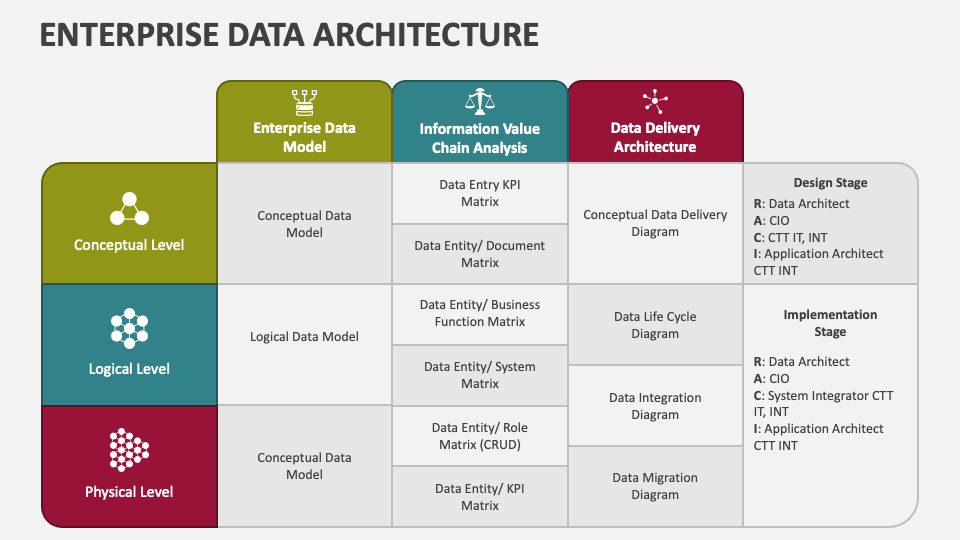
Data architecture defines how data should exist and flow across the enterprise.
Data governance defines how data should be owned, trusted, and controlled.
Without them:
- Data becomes fragmented
- Decisions lose credibility
- Strategic risk increases quietly
Strong enterprises don’t merely collect data.
They design authority into it and govern it deliberately.
Closing Thought for Enterprise Leaders
Data chaos is not an IT issue. It is a leadership exposure that compounds over time.
Enterprises that recognize this early build resilience, speed, and trust.
Those that ignore it continue to operate — but at a growing strategic disadvantage.